CH08. Execute, Validate, and Revise Through Pivoting
Questions This Chapter Answers
- Why is execution not “sticking to the plan” but “testing hypotheses”?
- Why is writing a good business plan document different from having a sound business plan?
- What do you need to connect to turn vague market research into decision-ready experiments?
- How do you design experiments whose risk you can actually afford?
- What evidence should a pivoting decision be based on?
- What does it take to translate a business model into an actual execution plan?
- How does material you accumulate over time become the evidence base for a business plan?
- What does AI help with in this process, and what does it not help with?
- How does the data gained from execution reconnect to the earlier chapters of this book?
Learning Objectives
By the end of this chapter, learners will be able to:
- Design execution as a hypothesis-testing activity rather than simple task performance.
- Distinguish between the business plan (the structure of hypotheses) and the business plan document (its output).
- Design validation using four elements: what to investigate, metrics, method and plan, and feedback data.
- Design small, repeatable experiments that stay within an affordable level of risk.
- Judge pivoting not by “did a new idea come up” but by “did the data shake the existing hypothesis.”
- Translate a business model into an execution plan that includes time, activities, resources, and cost.
- Understand how accumulating back data as you go reduces the burden of writing the business plan document.
- Explain a structure in which AI serves as a supporting layer while humans make the final call.
- Judge, based on execution data, which part of this book’s earlier chapters (customer, value proposition, business model, pricing/revenue model, effective market, etc.) needs to be reopened.
1. Core Concepts
Execution and pivoting are not an appendix tacked onto the business model completed in the earlier chapters. They are the domain where you actually investigate the questions and hypotheses that arose while reviewing market risk, product risk, and channel risk in the earlier chapters, and use the results to upgrade those earlier components. The purpose of execution is not to stick to the plan, but to find where the plan diverges from reality. You need to define the current situation as it actually is, confirm the gap against the desired situation, and then execute while taking on some risk to close that gap. Analysis alone confines your thinking to current constraints; only execution generates the next idea and the direction for revision.
Here you need to distinguish between the business plan and the business plan document. Writing the business plan document is not the whole of business planning. A business plan is not a completed set of facts but a structure of interconnected hypotheses. The hypothesis that a certain customer will feel the problem acutely, the hypothesis that you can reach the customer through a particular channel, the hypothesis that they will pay the price you propose, the hypothesis that you can secure the resources and activities you need — together these form a single business logic. Field validation is not the work of defending this hypothesis but of finding where it is wrong, and the business plan document is a byproduct built on the back data accumulated during that validation process. A team that has accumulated enough back data through the ongoing process of validating its item can write the business plan document relatively lightly. The strength of a good business plan document lies not in polished sentences but in the evidence that explains “why we made this decision.”
Execution is not a checklist confirming that planned tasks were performed. You need to be able to judge what you were trying to learn by taking the action, what changed as a result, and, based on that, which hypothesis to keep, revise, or discard. If execution and learning are not connected, your volume of activity increases but your business knowledge does not.
2. Key Frameworks and Mental Models
The four elements of validation design. The T-Canvas breaks execution and pivoting down into four elements: what to investigate, metrics, method and plan, and feedback data. When reviewing the earlier components raises a question like “are there no overseas customers?” or “does the need for localization actually exist?”, you first decide what to check (what to investigate), then decide specifically what to measure (metrics), and then choose your method and plan — interviews, VOC, key-man research, desk research, and so on. The validation results then become feedback data that revises the related components. Connecting these four elements in sequence turns a vague “market research” into a decision-ready experiment. The goal is not simply to conduct many customer interviews; the key is to connect, in advance, which hypothesis drives who you meet, what answer or behavior you’re confirming, and which decision the result will change. That said, there is no universal validation threshold that applies to every business, such as “X interviews are enough.” The sufficiency of evidence has to be determined by weighing the scale of the decision you’re validating against the risk if it turns out wrong.
Small, repeatable experiments. You can start field validation through interviews, VOC, key-man research, or partner outreach even without a finished product. What matters is not building a highly polished product first, but finding a cheaper way to check an uncertain hypothesis. The principle of “executing while taking on some risk” follows the same logic. If the cost and effort poured into an MVP are enough to bet the business on, that is closer to gambling than to an experiment. In a market that keeps changing, running repeated experiments requires keeping the risk exposure small. An experiment’s scale doesn’t need to match the business’s scale. You can test one channel before a nationwide rollout, open a sample store before opening every store, and confirm customer behavior before building out every feature. A good experiment is not one that shows off your chances of success, but one that makes the next decision more accurate.
Translating business strategy into an execution plan. Business model and business strategy are distinct. Where the business model explains the components and relationships needed for business success, business strategy is the activity plan that answers how to execute that model. Strategy must include activities such as sales, production, operations, and fundraising, along with their timing and associated costs. Simply writing “Key Activity: product development” is not enough — it needs to be broken down to the activity level: who does what, when, and with what external resources and cost. The quantitative review of the resulting costs, revenue, and funding needs must then be reconciled against the cost structure, revenue model, and Projected P&L worked out earlier, and if the execution plan conflicts with the numbers, the plan must be revised.
Back data and the Master Plan. Back data is the various material and information collected, organized, and processed during the business-planning stage. Instead of searching for material from scratch every time you write the business plan document, if you keep accumulating the evidence you need as you validate your item on an ongoing basis, writing the business plan document becomes closer to assembling that material for a given purpose. The Master Plan extends this idea into ongoing information management organized around Technology (T), Product (P), and Market (M). Under T you accumulate technical specs and technical advantages, under P you accumulate competing products’ features and customer reactions, and under M you accumulate industry reports and market-size data; when a call for proposals, an investment opportunity, or a new project comes up, you draw on this already-accumulated information and reassemble it into a business plan. The Master Plan is not a short-term document but a continuously updated system holding the company’s core technology and product roadmap.
3. Application Process
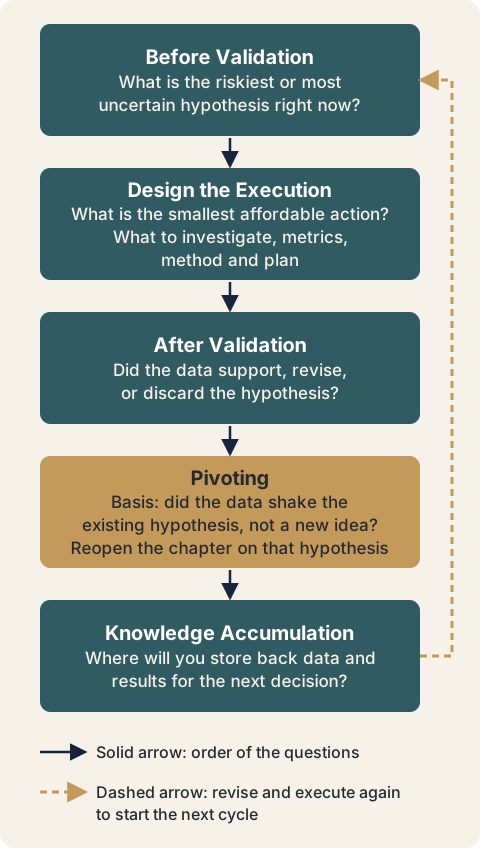
Execution can be run as a cycle that repeats five questions.
- Before Validation — What is the riskiest or most uncertain hypothesis right now, and what needs to be observed or measured?
- Design the Execution — What is the smallest affordable action that can confirm this hypothesis? (Use the four elements of validation design to specify what to investigate, the metrics, and the method and plan.)
- After Validation — Did the data support the existing hypothesis, prompt a revision, or lead you to discard it?
- Pivoting — Based on the result, which note do you need to reopen, and what needs to change? The basis for pivoting is not “did a new idea come up” but “did the data shake the existing hypothesis.” If the validation result shows that an assumption about customer, value, channel, price, or market boundary was off, that judgment becomes the grounds for reopening the earlier chapter that dealt with that hypothesis.
- Knowledge Accumulation — Where will you store the back data and execution results used in this judgment so they can be reused in the next decision?
Once you answer these questions, revise the relevant content, and execute again, you’re not closing out one cycle of business development — you’re starting the next one. As this cycle repeats, the accumulated record stops being a record of the past and becomes a living system for current decision-making.
The Execution Cycle at a Glance
In this process, AI can be used as a supporting layer that accelerates research and analysis. AI is helpful for summarizing and comparing collected material, drafting documents, and exploring alternatives, but if you use AI without understanding the overall business-development process, it becomes hard to judge at what point to use it and what to fix when its output turns out to be wrong. Theory determines what questions to ask, AI accelerates research and analysis, field data validates the hypotheses, and the final decision is made by a person. AI is not a separate stage of business development or the final decision-maker — it is a supporting layer that assists with research, analysis, drafting, and simulation at each stage.
4. Common Judgment Errors
- Treating execution as a checklist of “did we stick to the plan,” without recording what you were trying to learn by taking action and which hypothesis changed as a result. In this case, your volume of activity grows but your business knowledge does not.
- Focusing on polishing the wording of the business plan document while not accumulating, as you go, the back data that backs it up (customer interviews, competing-product data, pricing research, failed experiments, resource/cost review).
- Treating the research activity itself as the goal — “let’s just do a lot of interviews” — without first deciding what to check (what to investigate) and what to measure (metrics).
- Pouring so much cost and effort into an MVP or experiment that it effectively bets the business’s fate on it, turning the experiment into a gamble.
- Basing the rationale for pivoting on a gut feeling that “a new idea came up,” rather than on which specific data shook which specific hypothesis.
- Writing the business model only as declarations like “Key Activity: product development,” without breaking it down to the execution level of who does what, when, and with what resources and cost.
- Pushing ahead with an execution plan even when its numbers conflict with the cost structure, revenue model, and Projected P&L established earlier, instead of revising the plan.
- Treating AI-generated summaries, drafts, or exploration of alternatives as the final judgment, without a person deciding what to prioritize when actual field data conflicts with AI’s reasoning.
5. Practical Application Questions
- What is the riskiest or most uncertain hypothesis in our business plan right now? If that hypothesis turns out wrong, which of customer, value, channel, price, or market boundary would be shaken the most?
- What validation methods (interviews, VOC, key-man research, partner outreach, etc.) can you start with, without a finished product, to check this hypothesis?
- In this experiment, what will you check (what to investigate), with what metrics, and using what method and schedule (method and plan)?
- If this experiment fails or turns out differently than expected, what cost and time can you afford to absorb? Does the experiment fall within that range?
- Did the data from your recent execution support the existing hypothesis, prompt a revision, or lead you to discard it? What is the basis for that judgment?
- Based on this result, which chapter of this book (customer, value, channel, pricing/revenue model, or effective market) needs to be reopened?
- Have you broken down your business model’s key activities to the level of “who, when, what, with what resources and cost”?
- Where, and in what form, are you accumulating the back data (interview records, research material, failed experiment results, etc.) that has come out of your validation process so far? Is it in a state you can pull directly into your next business plan document?
- Of the research, analysis, and drafting you’ve handed to AI, how much was support, and where did a person make the final call? Is that boundary clear?
6. Connection to the Next Chapter
This is the final chapter of this book, but business development does not end just because execution has ended. The data gained from execution instead becomes the starting point that shakes the assumptions of the earlier chapters again. If you discover a new customer or buyer, reopen CH03 (Customer/Buyer); if the selection criteria change, reopen CH04 (Value/Selection Criteria); if the channel or partner structure changes, reopen CH05 (Channel/Partner); if the price, cost, or revenue structure no longer fits, reopen CH06 (Price/Cost/Revenue Model); if the actual sellable quantity and market boundary change, reopen CH07 (Effective Market) and revise. If the market opportunity or product hypothesis itself changes, you go all the way back to CH02 (Market Opportunity/Product Hypothesis). And if the founder’s desired level of growth, target profit, or risk tolerance has itself changed through execution, you can revisit the very first standards and purpose (CH01) as well.
In other words, this chapter is not the chapter that closes the book — it is the entry point to a cycle that answers the five questions of before validation, designing execution, after validation, pivoting, and knowledge accumulation, and loops back into the earlier chapters. As this cycle repeats, the content covered in each chapter of this book stops being a document written once and finished, and becomes a living body of knowledge continuously updated for present-day decisions.
Key Takeaways
- Execution is not about sticking to the plan; it is a hypothesis-testing activity that finds where the plan diverges from reality.
- A business plan is a structure of interconnected hypotheses, and the business plan document is a byproduct built on the back data accumulated during that validation process.
- Validation must be designed by connecting four elements — what to investigate, metrics, method and plan, and feedback data — for vague research to become a decision-ready experiment.
- A good experiment is small, repeatable, within an affordable level of risk, and makes the next decision more accurate.
- Pivoting is judged not by whether a new idea came up, but by whether the data shook the existing hypothesis.
- Business strategy is an execution plan that translates the business model into time, activities, resources, and cost, and must be revised if it conflicts with the numbers.
- Back data and the Master Plan share an operating philosophy of accumulating the evidence for your judgments as you go, instead of scrambling to produce documents only when needed.
- AI is only a supporting layer that accelerates research, analysis, and drafting — taking on risk and making the final decision remain a human responsibility.
- Execution data tells you which of this book’s earlier chapters (customer, value, channel, price, effective market, market opportunity, purpose) needs to be reopened, turning this entire book into an ongoing learning cycle rather than a one-time project.
Source Map
- MN: MN08 Execution, Validation, Pivoting, and Business Planning
- KM (public-eligible):
- KM064 Execution Is Hypothesis Testing
- KM065 Distinguishing the Business Plan from the Business Plan Document
- KM066 The Four Elements of Validation Design
- KM067 Small, Repeatable Experiments
- KM068 Data-Driven Pivoting
- KM069 Translating Business Strategy into an Execution Plan
- KM070 Back Data and the Master Plan
- KM071 The Role of AI and Human Judgment
- KM073 The Execute → Data → Revise → Re-execute Loop