CH05. Designing the Business Model
Questions This Chapter Answers
- Why is a business model the operating logic of a business, not just a single canvas?
- Why shouldn’t the nine boxes of the BMC (Business Model Canvas) be filled in independently of one another?
- How are value delivery, value creation, and value capture connected around the Value Proposition?
- What does it mean to read the BMC as a map of decisions rather than a form to fill out?
- How is the T-Canvas different from the BMC, and why does it extend into a Business Development “process”?
- How does the Business Model Story check for coherence in a different way than the canvas does?
- What criteria let us judge that a business model has been “designed”?
Learning Objectives
By the end of this chapter, learners will be able to:
- Explain a business model not as a document describing what to sell, but as an operating logic that connects three axes: creating customer value, delivering it, and making money.
- Describe, in connected sentences, how changing one box of the BMC changes the others.
- Distinguish the components of value delivery (Customer, Channel, Customer Relationships), value creation (Key Resources, Key Activities, Key Partnerships), and value capture (Cost Structure, Revenue Streams), and explain why they must connect around the Value Proposition.
- Use the T-Canvas and the Business Model Story to treat a business model not as a static deliverable but as a structure that is meant to be validated and revised.
- Self-check whether their own business model is ready to move to the next stage (cost, price, business feasibility).
1. Core Concepts
The concept of a business model has been explained differently by different researchers. Some perspectives emphasize transaction structure and the roles of participants; others center on customer value, competitive advantage, and revenue sources. The wording differs, but the common ground is clear. A business model is not simply a document describing what to sell — it is the operating logic that connects multiple elements so that a business can keep delivering value to customers while sustaining itself. Reviewing this body of prior research, the recurring common axes can be organized into creating customer value, delivering customer value, and the structure for making money. A company must actually create the value it promises customers, deliver that value in a suitable way, and be able to cover the costs incurred in the process while capturing revenue. (KM034)
The BMC is the representative tool for laying out this logic on a single page. Around the Value Proposition at the center, value delivery elements such as Customer, Channel, and Customer Relationships sit on one side, value creation elements such as Key Resources, Key Activities, and Key Partnerships sit on the other, and Cost Structure and Revenue Streams sit at the bottom. But the real usefulness of the BMC does not lie in the nine boxes themselves. What matters more is that it lets you compare, at a glance, whether different choices can hold true simultaneously within a single business. (KM034)
The most common error when applying a business model to an actual business is treating each component as an independent question. Who is the customer, what is the channel, what are the key resources — answer each one separately and the canvas gets filled in. But if each answer presupposes a different strategy, the model does not work. The core of business model design is not what you wrote in a given box, but whether you can explain how one decision changes the other components. The key criterion for judging this is coherence. You need to look, together, at whether the value promised to the customer matches the product specification, whether the channel and customer relationship used to deliver that product match the price and customer experience, whether the resources, activities, and partners needed to fulfill that promise actually exist, and whether this whole structure can hold up in terms of cost and revenue. (KM035)
The influence can also run in the opposite direction. If a company already has a strong offline sales network in a particular region, it may be more realistic to choose the customers who can make the most effective use of that key resource. Market needs sometimes determine resources and activities, but resources and capabilities already secured can, in turn, constrain or favor the choice of customers and channels. A business model is not a one-directional checklist that starts from the customer and flows outward — it is a network of relationships in which multiple elements push and pull against each other. (KM035)
2. Key Frameworks and Mental Models
2.1 Connecting three structures around the Value Proposition
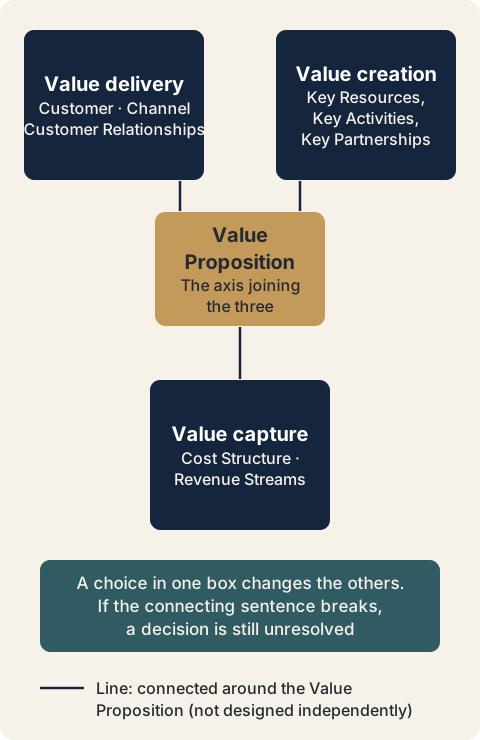
Around the axis of the Value Proposition, the business model divides into three structures — value delivery, value creation, and value capture — and these three cannot be designed independently of one another.
Value delivery (Customer, Channel, Customer Relationships). A customer segment is not simply a list of demographics. Which customers you choose changes the value you must provide, along with the product specification, channel, and customer relationship. So the right sequence is not to search for customers anew, but to check what delivery structure is required by the buyer and Value Proposition you have already chosen. A channel is not simply a place of sale — it is the entire interface through which the customer contacts the company, understands and evaluates the product, purchases it, receives it, and gets after-sales support. Even for the same product, whether the customer is B2C, B2B, or B2G determines whether an online store, direct sales, partner sales, or public procurement is the appropriate channel, and a change in channel also changes the customer relationship approach, the cost of sales, and the customer experience. Customer Relationships are not about friendly service — they are the way you acquire, retain, and expand customers. Relationship approaches such as personal assistance, dedicated account management, self-service, automation, and community each require different staffing, systems, and costs. Designing the delivery structure means examining not only “where will we sell” but also “what experience will we sustain at what cost.” (KM036)
Value creation (Key Resources, Key Activities, Key Partnerships). Key Resources are not a list of everything the company happens to own — they are the resources that are indispensable for realizing the Value Proposition, reaching customers, and generating revenue. Which of technology, specialized personnel, production facilities, data, brand, patents, or sales network is the key resource depends on the business model chosen. Key Activities are the actual actions that use these resources to create value. In a manufacturing startup, activities such as technology development, product development, production, quality control, sales, and after-sales service must be sorted by which ones connect directly to customer value; once the key activities are set, the required key resources also come into focus, and you can judge which activities to perform internally and which to outsource. Because a startup can rarely hold every resource and activity in-house, partnerships are structurally important. A partner, however, is not just a name that fills a resource gap. You need to examine which resources and activities you depend on whom for, and how that dependence affects cost, negotiating power, and supply stability. (KM037)
Value capture (Cost Structure and Revenue Streams). Cost Structure and Revenue Streams are the point where the business model meets reality. But the role of this stage is not to calculate cost or set price. It is limited to confirming what cost and revenue structure results from the choices already designed for customer, channel, resources, and activities. In the business modeling process, the revenue structure can be framed as How to Sell, and the cost structure as How to Make. Customer, customer touchpoint, market segment, and charging method indicate the direction in which revenue is created, while key activities, resource acquisition, and the choice between doing things in-house, outsourcing, or partnering indicate the direction in which cost is incurred. This connection has to be made before moving on to the Projected P&L. The specific cost calculation, pricing, margin, charging method, and Revenue Model are developed further in the next stage (CH06). (KM038)
The Three Structures at a Glance
2.2 Reading the BMC as a map of decisions
The BMC is not simply a brainstorming tool — it is the result of decisions made under the constraints of the external environment and internal capabilities. From this perspective, filling in a box does not mean deciding on a noun for that box; it means making a choice that also considers its relationship to the other boxes. Choosing a customer changes the value and channel; changing the channel changes the relationship-management approach and cost; and constraints on key resources can, in turn, change the customer and product mix. When reviewing the BMC, it is more useful to build connecting sentences than to check the completeness of each box. “This customer wants this value because of this problem. We choose this channel and this relationship approach to deliver this value. We need this resource and this activity to fulfill this promise, and we secure what is missing through this partner. This structure produces this shape of cost and revenue.” If this sentence does not flow naturally, it means some decision somewhere on the canvas has not yet been resolved. The role of the BMC is not to design the business for you — it is to show whether the business’s different choices can hold true at the same time, and to help you discover where logical conflicts arise. (KM039)
2.3 T-Canvas: extending a static model into a Business Development process
The T-Canvas does not have the same structure as the BMC. It is closer to a tool that lays out the business modeling process on a single page so that a technology entrepreneur examines market risks and opportunities, clarifies the customer and the problem, connects the solution with product development partners, and reviews competitive advantage against competing and substitute products along with customer touchpoints and channels. The first row covers exploring risks and opportunities using PEST, the second row covers overcoming product risk and Business Development, and the third row covers overcoming pathway risk and the Value Proposition. An important feature of the T-Canvas is that it connects top-down and bottom-up thinking within a single process. While examining the external environment and industry structure to explore opportunities and risks, it also builds up the customer’s problem and solution, and the actual product and partners, from the bottom up. This keeps the judgment “the market looks good” from being made separately from “our technology is good” — it confirms whether external opportunity and internal capability meet within a single business structure. What matters is that the business model is not written from the start as a finished answer, but as a structure meant to be validated and revised. (KM040)
2.4 Business Model Story: re-checking through the customer’s purchase logic
Organizing many components on a canvas does not automatically mean the business’s logic is explained. The process of rearranging what has been reviewed through business modeling around customer value is called the Business Model Story. It starts from a serious customer problem, and moves through the limits of existing solutions, the company’s differentiated solution and Competitive Advantage, to the final customer value, connected as a single flow. The value of this is not in making the pitch sound impressive. If there is a logical jump between the customer problem and the value, if the Competitive Advantage does not connect to the comparison criteria the customer actually cares about, or if the path to the actual point of purchase is unclear, the flow of the story breaks. Such a break is a signal that an unresolved contradiction still exists among the components of the business model. If the canvas is a map that lets you check the relationships among multiple components at once, the Business Model Story is a way of reading that same map as a single-direction sentence following the customer’s purchase logic. Used together, the two check structural coherence and the persuasiveness of customer value in different ways. (KM041)
3. Application Process
- Check the three axes first. Lay out the basic skeleton — creating customer value, delivering customer value, and the structure for making money — and first sort out what belongs on each axis. (KM034)
- Fill in value delivery, value creation, and value capture around the Value Proposition. For value delivery, organize Customer, Channel, and Customer Relationships; for value creation, organize Key Resources, Key Activities, and Key Partnerships; for value capture, organize the direction of Cost Structure and Revenue Streams (How to Sell / How to Make). (KM036, KM037, KM038)
- Re-read each box as a connecting sentence. Check whether the sentence “This customer wants this value because of this problem → we deliver it through this channel and relationship approach → we realize it with these resources, activities, and partners → this produces this cost and revenue structure” flows without breaking. (KM039)
- Extend to the T-Canvas if needed. Especially where market risk and product risk coexist, as in technology startups, lay the review out as a Business Development process — from exploring risk and opportunity, through overcoming product risk, to overcoming pathway risk. (KM040)
- Re-check with the Business Model Story. Rewrite the content, not as a canvas but as a single-direction story following the customer’s purchase logic, and check for points where the flow breaks. (KM041)
- Judge whether it is complete. Confirm that the customer value is clear, that a channel and relationship structure exists to deliver it, that the resources, activities, and partners can be secured, and that these choices connect without contradiction. Here, “complete” does not mean the business will succeed — it means the model has reached a state that can be calculated and validated in the next stage. (KM042)
4. Common Judgment Errors
- Mistaking the business model for a document describing “what to sell,” instead of seeing it as the operating logic of creating, delivering, and making money from customer value. (KM034)
- Treating the nine boxes of the BMC as independent questions, without checking whether the answer in one box presupposes a different strategy than another. (KM035)
- Treating the customer segment as nothing more than a list of demographics, missing the fact that the choice of customer changes the value, product specification, channel, and customer relationship as a whole. (KM036)
- Listing key resources as “everything the company owns,” without screening for which resources are actually necessary to realize the Value Proposition. (KM037)
- At the value capture stage, either trying to calculate cost and price prematurely, or conversely, skipping the connection between the cost/revenue structure and the prior choices (customer, channel, resources, activities) altogether. (KM038)
- Using the BMC only as a completeness checklist, and skipping the step of building connecting sentences between boxes to find logical conflicts. (KM039)
- Separating market risk and product risk, judging “the market is good” and “our technology is good” independently, without checking whether the two meet within a single business structure. (KM040)
- Treating the Business Model Story only as a presentation storytelling technique, rather than as a tool for checking logical breaks among customer problem, solution, competitive advantage, and customer value. (KM041)
- Mistaking the “completeness” of a business model for the success or finalization of the business, overlooking the fact that quantitative validation in the next stage (cost, price, market size) still remains. (KM042)
5. Practical Application Questions
- Can we summarize our business model in three sentences covering creating, delivering, and making money from customer value? (KM034)
- If we change the customer segment in the BMC, which of the Value Proposition, channel, or key resources must also change? (KM035)
- Do the channel and customer relationship approach we have chosen match the price and experience the customer expects? (KM036)
- Among our key resources and key activities, which do we perform internally and which do we depend on partners for? How does that dependence affect cost, negotiating power, and supply stability? (KM037)
- Do our revenue structure (How to Sell) and cost structure (How to Make) point in the same direction as the customer, channel, resources, and activities we chose earlier? (KM038)
- Starting from “this customer wants this value because of this problem,” does the logic flow without a break all the way to “this produces this shape of cost and revenue”? (KM039)
- In our business, which is still unvalidated — market risk or product risk? (KM040)
- When written out as a Business Model Story, where is the segment with a logical jump between customer problem, solution, competitive advantage, and customer value? (KM041)
- Right now, are our customer value, delivery structure, creation structure, and cost/revenue direction connected into a single logic solid enough to move to the next stage (cost, price, and business feasibility validation)? (KM042)
6. Connection to the Next Chapter
This chapter checked Cost Structure and Revenue Streams only in terms of direction — “How to Make” and “How to Sell.” The specific cost calculation, pricing decision, margin, charging method, and Revenue Model were explicitly set aside as outside the scope of this chapter (KM038). It was also established that the “completeness” of a business model does not mean the business will succeed, but that it has reached a state that can be calculated and validated in the next stage — and that economic and practical constraints, such as whether the value the customer wants demands too much cost, or whether securing the key resources is realistic, must be validated in the following stage (KM042). CH06, “Designing Cost, Price, and the Revenue Model,” is precisely the stage that takes the cost structure and revenue streams whose direction was only confirmed in this chapter and develops them further into concrete numbers and decisions.
Key Takeaways
- A business model is not a document describing what to sell — it is the operating logic of a business, connecting three axes: creating, delivering, and making money from customer value.
- The core of good business model design is not the completeness of individual boxes, but coherence — the ability to explain how one decision changes the other components.
- Around the Value Proposition, value delivery (Customer, Channel, Customer Relationships), value creation (Key Resources, Key Activities, Key Partnerships), and value capture (Cost Structure, Revenue Streams) must connect to one another.
- The BMC is not a final answer but a map showing the causal relationships among decisions; its role is to build connecting sentences and find logical conflicts.
- The T-Canvas connects market risk and product risk into a single Business Development process, and the Business Model Story re-checks the same content through the customer’s purchase logic.
- The “completeness” of a business model does not mean the success of the business — it means reaching a state that can move on to the next stage: cost, price, and business feasibility validation.
Source Map
- MN: MN05 Business Model Design
- KM: KM034–KM042
- KM034-business-model-definition.md
- KM035-business-model-consistency.md
- KM036-value-delivery.md
- KM037-value-creation.md
- KM038-value-capture.md
- KM039-bmc-decision-map.md
- KM040-t-canvas.md
- KM041-business-model-story.md
- KM042-business-model-completeness.md