CH03. Defining the Customer, the Buyer, and the Problem
Questions This Chapter Answers
- Why is defining the customer a matter of defining the market, not the product?
- Are the person who experiences the problem, the person who decides to buy, and the person who pays always the same person?
- How does the logic that drives a purchase differ across transaction types (B2C, B2B, B2G)?
- Is the customer segment a fixed answer from the start, or a process of narrowing down as you go?
- Does the mere fact that a customer “has a problem” open their wallet, or are other conditions needed?
- How do you turn what customers say in the field into language you can use for comparison and purchase decisions?
- Why do customers with the same problem still end up in different segments?
- Why doesn’t a severe problem with a clear buying factor always translate into sales?
Learning Objectives
By the end of this chapter, you will be able to:
- Explain how defining the customer simultaneously changes the market’s name, size, competitive structure, and channels.
- Separate the roles of User, Buyer, and Payer and apply them to your own business.
- Distinguish what governs purchasing in B2C, B2B, and B2G respectively.
- Re-draw market segments based on “shared problems” rather than demographic criteria.
- Distinguish whether a problem exists from how severe it is, and ask the questions that reveal severity.
- Translate problems from the field into “attribute” language that is comparable and usable in the market.
- Refine the target customer to an actionable level by examining the Key Buying Factor (KBF) alongside customer touchpoints.
1. Core Concepts
Business Planning often starts from “what will we build,” but how you define the customer is what determines the market first. Even with the same technology and the same item, choosing who the customer is changes the market’s name, size, competitive structure, and required channels entirely. If you view the market as the set of actual and potential buyers, then estimating market size itself requires first defining who the buyer is. Take the same product: sell it directly to individuals and the individual becomes the buyer; supply it to a company and the company becomes the buyer. As the transaction relationship and the planner’s definition of the customer change, the boundary of the market changes along with them.
What matters here is not stopping at a broad customer segment such as “women in their 20s and 30s” or “the mass market.” You need to go further — passing the definition through the external environment and internal Capability to arrive at the actual target you will pursue. In other words, defining the customer is not a noun you attach once and move on from; it is a decision you narrow down with evidence.
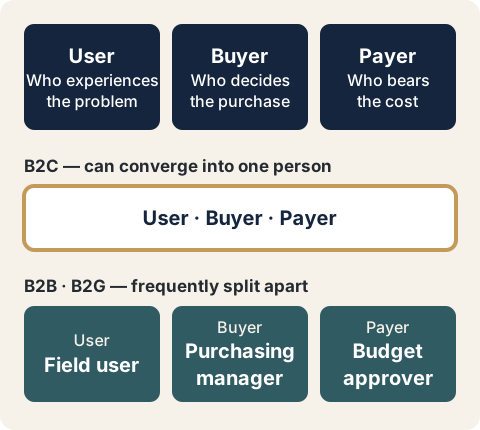
Another point that is easy to miss when defining the customer is that the word “customer” can actually refer to different roles. The User who actually experiences the problem, the Buyer who decides the purchase, and the Payer who bears the cost can all converge into one person in B2C, but in B2B and B2G they are frequently split into the field user, the purchasing manager, and the budget approver. Even if an engineer has technically solved a problem in the field, if the purchasing manager doesn’t recognize it as their problem, the sale may never happen. That’s why the technical effect that matters to the User must be re-communicated in the language of cost, performance, and risk that the Buyer can understand.
User, Buyer, and Payer at a Glance
2. Key Frameworks and Mental Models
Distinguishing the buying logic by transaction type. In B2C, an individual’s everyday inconveniences and desires can translate fairly directly into purchase behavior. In B2B, by contrast, a purchase is often tied to organizational performance — the counterpart company’s cost savings, revenue growth, productivity, quality, delivery, or operational risk — and the User and the purchasing decision-maker are easily separated. In B2B transactions, bargaining power and relationship-specific investments can make deal information asymmetric, so rather than relying only on published industry statistics to understand the customer, you also need to examine the actual purchasing entity, the transaction method, and the supply relationship. In B2G, institutional conditions such as budget, statutes, and procurement method constrain the actual purchase. Even if the field department using the product strongly feels the need, without a budget line item or a procurement basis, it may never lead to a purchase. Customer definition in the public-sector market must therefore include not just the using department but also the organizational structure that decides budget and procurement.
Customer segments are discovered and chosen. A resource-constrained startup must focus on a customer group that is measurable, accessible, and has a meaningful scale. Add internal Capability and feasibility to this, and even a customer group with large market demand may be hard to pursue as an early target if it can’t currently be reached. The early target goes through a repeated process of review and re-narrowing — reviewing price, channel, available resources (Quality, Delivery), and input cost. Defining the customer is not a task you finish once; it’s a decision that keeps being revised as it interacts with other business elements.
Redefining the market by problem, not product. In early Business Development, you can use “do they share the same problem” as a segmentation criterion, alongside external attributes like gender, age, region, or industry. You can also expand a segment by finding other customer groups who share part of the same problem as a given customer. Placing the job the customer is trying to get done at the center — instead of the product category — changes who the competition is and what the market scope is, and can sharpen the market’s real boundary.
The existence and severity of a problem. A problem can be described as the gap between the ideal state a customer wants and their current reality. The clearer this gap is and the more strongly the customer feels the deficit, the more likely they are to accept a new solution. However, the mere existence of a problem is not enough. If a problem exists but the customer feels it’s tolerable, their reason to pay is weak. Conversely, if the loss caused by the problem — in time, money, revenue, safety, or convenience — is large, the value of solving it grows as well. When documenting a customer problem, don’t stop at “what’s inconvenient” — confirm how often it occurs, what alternative the customer currently relies on to get by, and what they are losing because of it.
Attributes: translating the problem into the language of the market. Rather than connecting the customer problem straight to a solution, there is a method that inserts a “problem → attribute” step. An attribute is a device that translates the various problems that surface in the field into core keywords the Buyer and the planner can understand. One example is turning a field problem expressed in a specialized technician’s language into language usable for comparison and purchase decisions — such as data processing speed or measurement stability. This step’s boundary stops right there. An attribute is not yet a solution or a Value Proposition; it is the result of clearly understanding the customer problem and organizing it into language that is comparable in the market.
Key Buying Factor (KBF) and customer touchpoints. The Key Buying Factor that drives a purchase can differ by segment. When what customers value differs — price, speed, quality, freshness, atmosphere, process efficiency — customers with the same problem end up in different segments. If KBF addresses “what makes them choose,” the customer touchpoint addresses “where can you reach them.” The reason to look at “customer and touchpoint” together is to narrow down to the targets an early-stage startup can actually meet and sell to. In B2B and B2G especially, the purchasing manager or the ordering department — not the User — can be the key customer touchpoint. If the customer touchpoint is unclear, even a large customer problem is unlikely to convert into revenue.
3. Application Process
- Customer definition = setting the market boundary. Don’t stop at a broad noun for the customer — refine it into the actual target you will pursue, having passed it through the external environment and internal Capability.
- Separate the roles. Confirm whether the User, Buyer, and Payer are the same person or different people. If they differ, work out each role’s decision criteria and touchpoint separately.
- Check the transaction type. Depending on whether this business is B2C, B2B, or B2G, examine the conditions that drive the purchase differently (an individual’s inconvenience/desire / organizational performance / budget, statutes, and procurement method).
- Discover and narrow the segment. Select the early target based on measurability, accessibility, scale, and internal Capability, then repeatedly re-adjust it by reviewing price, channel, available resources, and input cost.
- Redefine by problem. Instead of demographics or industry, re-draw the segment using “do they share the same problem” as the criterion.
- Confirm the problem’s severity. Concretely document the problem’s frequency, the current alternative, and the resulting loss, to judge whether the problem merely exists or is severe enough that customers will pay to solve it.
- Translate into attributes. Turn the problem expressed in field language into the market’s comparable, purchasable language (attributes). Don’t jump straight to a solution or product idea at this stage.
- Confirm KBF and customer touchpoint. Refine the target customer to an actionable level by working out together what this segment bases its purchase decision on (KBF) and where you can actually reach this customer (customer touchpoint).
4. Common Judgment Errors
- Defining the customer with a broad noun like “women in their 20s and 30s” or “the mass market” and mistakenly thinking that’s the end of it — the decision to narrow down to the actual target is missing.
- Lumping the User, Buyer, and Payer together under the single word “customer” without distinguishing them, and missing the party who actually drives the purchase decision.
- In B2B and B2G businesses too, looking only at individual inconvenience and desire the same way you would in B2C, without checking institutional conditions such as organizational performance or budget/procurement structure.
- Treating the early target segment as a fixed answer once chosen, without reflecting that it needs to be re-narrowed as price, channel, and Capability change.
- Confirming only that a problem “exists” without checking whether it is actually “severe” enough for customers to pay to solve it.
- Carrying the raw, uncomfortable language heard in the field straight into the business plan, skipping the step of translating it into market language (attributes) the Buyer can understand.
- Jumping straight from the problem stage to a solution or product idea, skipping the intermediate step of organizing attributes.
- Treating all customers with the same problem as a single segment, missing the fact that a different Key Buying Factor makes them a different segment.
- Organizing the customer problem and buying factor well, but never separately confirming how you will actually reach that customer (customer touchpoint).
5. Practical Application Questions
- Is the term “customer” I’m using right now a noun (a label), or a decision backed by evidence?
- In this business, who experiences the problem, who decides the purchase, and who pays the cost? Are they the same person, or different people?
- Which of B2C, B2B, or B2G does this transaction fall under, and is the condition that drives the purchase an individual’s inconvenience, organizational performance, or budget/statutes/procurement method?
- Is the current target customer group measurable, accessible, of sufficient scale, and reachable with our Capability?
- Looking again through the lens of “shared problem” instead of demographics or industry, how does the boundary of our market change?
- How often does this problem occur, what alternative is the customer currently relying on to get by, and what are they losing because of it?
- What keywords result from translating what customers say in the field into comparable, purchasable attribute language?
- What is this segment’s Key Buying Factor (KBF), and where is the customer touchpoint where you can actually reach this customer?
6. Connection to the Next Chapter
This chapter defined the customer, worked through the problem that customer experiences in the order of existence, severity, and attributes, and narrowed the target customer to an actionable level through the Key Buying Factor and customer touchpoints. What’s left in hand as a result is “whose problem, and in what attribute language we organized it” — not yet “how we will solve that problem and offer something different from competitors.” Building on a customer whose problem and attributes are now organized, the next task is which Value Proposition to connect those attributes to, what Competitive Advantage to hold relative to competitors, and how to position that advantage in the market. This is covered in CH04. Value Proposition, Competitive Advantage, and Positioning.
Key Takeaways
- Defining the customer is the same act as defining the market’s name, size, competitive structure, and channels; customer definition is a decision, not a noun.
- User, Buyer, and Payer may be the same or different people, and at minimum these three roles must be distinguished.
- B2C, B2B, and B2G each have a different buying logic — an individual’s inconvenience/desire, organizational performance, and budget/statutes/procurement method, respectively.
- A customer segment is discovered based on measurability, accessibility, scale, and internal Capability, and is a process that keeps narrowing through repeated interaction with other business elements.
- The market can be redefined not by product category but by the problem customers share.
- The mere existence of a problem is not enough — the larger the gap between the ideal and reality, and the larger the resulting loss, the greater the severity.
- A problem expressed in field language must be translated into the comparable, purchasable market language of “attributes,” and you should not jump straight to a solution at this stage.
- Customers with the same problem still become different segments if their Key Buying Factor (KBF) differs, and if the customer touchpoint is unclear, even a large problem won’t translate into revenue.
Source Map
- MN: MN03 Customer, Buyer, and Problem
- KM: KM018–KM026
- KM018-customer-definition-market-boundary.md
- KM019-user-buyer-payer.md
- KM020-b2c-b2b-b2g-purchasing-structure.md
- KM021-customer-segmentation-targeting.md
- KM022-problem-based-market-redefinition.md
- KM023-problem-existence-and-severity.md
- KM024-problem-attributes.md
- KM025-key-buying-factor.md
- KM026-customer-touchpoint.md