CH01. Setting Your Business Criteria
Questions This Chapter Answers
- Where should Business Development start — from an item, from a market, or from something else?
- What does business success mean to me?
- What do I want to earn, and how much? Am I aiming for revenue or profit?
- How much growth do I want, and what price am I willing to pay for it?
- Which opportunities and activities will I choose not to pursue?
- How do these criteria connect to the later review of market, pricing, and feasibility?
- How can these several criteria be brought together into a single priority system?
- When, and for what reasons, should these criteria be reopened?
Learning Objectives
By the end of this chapter, learners will be able to:
- Explain the principle that Business Development starts not from an item or a market, but from the entrepreneur’s own judgment criteria.
- Define each of the four individual criteria: lifestyle, target revenue (revenue/operating profit), growth scale, and Not-to-do.
- Understand that these individual criteria can be brought together into a single priority system, and provisionally organize their own priorities.
- Explain how business purpose and target revenue serve as inputs to the later stages of market-size estimation, pricing, and feasibility review.
- Judge when their own criteria need to be reviewed again.
1. Core Concepts
Business Development does not start with finding a good item or analyzing a market. After starting a business, if you keep chasing external demands — subsidies, investment, hiring, sales expansion — the company may grow, but why the founder started the business in the first place can become blurred. This is why the starting point of Business Development is not external opportunity, but the entrepreneur’s own criteria.
The “criteria” referred to here are not an abstract mission statement. They are judgment conditions — concrete enough to apply to actual business decisions — that define what kind of life you want to maintain, how much income and growth you want, and which risks and sacrifices you will accept and which you will decline. The premise of setting “someone who can determine their own lifestyle” as the value proposition, and thinking first about what kind of life you want to live before worrying about how much to earn, develops into concrete judgment criteria connected to target revenue, growth, and Not-to-do.
The first piece of this criteria is the definition of success. Business success can be judged not by how it looks to others, but by whether it matches the lifestyle you wanted. Not every founder needs to aim for billions in revenue and an IPO, and if you don’t need that much money, it is worth reconsidering the risks and sacrifices you would have to accept to reach that scale. The same business cannot be a good business for someone who says “I just want to do what I love and earn a certain amount each month” and for someone who says “I’m going all the way to IPO.” The former may value a small organization, low fixed costs, and high autonomy, while the latter may have to accept a larger market, faster growth, fundraising, and organizational expansion. Defining business success by revenue alone makes the criteria easy to destabilize, so it is necessary to first determine what outcomes actually matter to the entrepreneur — not just revenue, profit, and company valuation, but also autonomy over time, organization size, place of residence, time with family, and social purpose — and then set priorities among them.
2. Key Frameworks and Mental Models
For the definition of success to be usable in actual decision-making, it must be broken down into several concrete criteria. This chapter covers two axes: target revenue and growth scale.
Target revenue is a business constraint that must be set before market size. Rather than starting from a huge market size, the priority is to first decide “how much do I want to earn.” This is because a large, high-growth market and the entrepreneur’s ability to generate the level of income they want are two separate facts. Even if the overall market is small, if you can reliably hit your target revenue, that business can be meaningful enough for the entrepreneur. Here, target revenue is vague if written as a single number like “1 billion won in revenue.” Revenue and operating profit are distinct. Revenue shows scale as the total money that came into the company, while operating profit is closer to what the business actually kept after deducting cost of goods sold and selling, general, and administrative expenses. Someone who wants fast top-line growth and someone who wants stable profit may need to manage different key metrics, so at minimum you need to distinguish “which metric, at what level, and why you want it.”
Growth scale is not a default that should automatically follow, but a strategic condition the entrepreneur must choose. Building a business at a scale capable of going public requires being able to take on that much risk, and any choice comes with a trade-off. Growth can bring costs such as organizational management, fixed costs, fundraising responsibilities, investor expectations, and the dispersion of the founder’s time. Conversely, if you clearly want high company valuation and fast growth, you need to choose the strategy that accepts those costs. What matters is not which is “right” — growth or non-growth — but whether the growth level you want fits your business model, resources, and risk tolerance.
Once judgments on target revenue and growth are settled, you can finally set your Not-to-do. Before making a Business Development to-do list, you should first think through a Not-to-do list. Building a proper execution list requires criteria for deciding which proposals and opportunities to decline. Without such criteria, every incoming government program, investment offer, collaboration, or new item can look like something you must do. Not-to-do is not simple renunciation — it is the choice to allocate more of your limited resources (people, money, time, focus) to your core business by deciding where not to spend them.
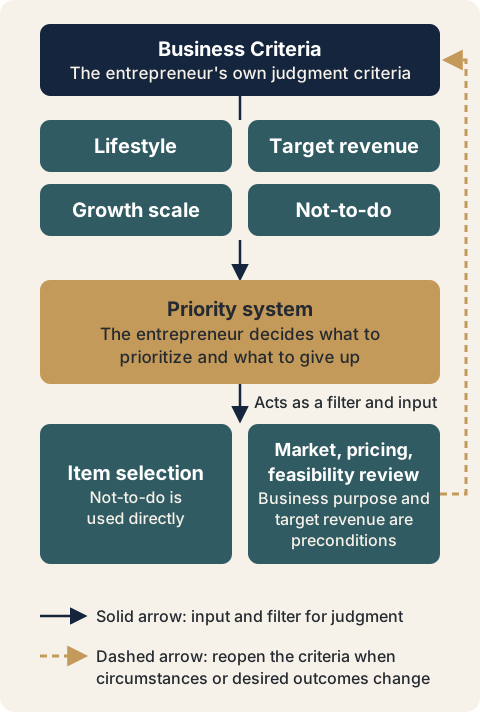
These several criteria (lifestyle, target revenue, growth scale, Not-to-do, risk tolerance, use of time, organization size, investor relations, social purpose, etc.) can be brought together into a single priority system. Only when each criterion is organized together — deciding what to prioritize and what to give up — rather than treated separately, do they function as an actual decision-making standard for the business. Looking at the same market data and the same business opportunity, someone who prioritizes “fast growth and high company valuation” and someone who prioritizes “a small organization, stable profit, and staying in one region” can reach different conclusions. Data provides grounds for a choice, but the entrepreneur decides what to prioritize.
Business Criteria at a Glance
3. Application Process
The criteria set this way are not mere declarations — they serve as actual inputs to the rest of the Business Development process. In the first stage of the Effective Market estimation framework, idea and environment analysis, you first confirm “how much do I want to earn by selling this product” and “what is the ultimate purpose of this business.” After that, you narrow down market size by reviewing customers, positioning, pricing, available resources, and input costs. In other words, business purpose is placed ahead of market-size calculation.
Here, it is important to distinguish between defining a business purpose and verifying whether that purpose is actually achievable. Business purpose defines “what outcome do I want,” and target revenue is not the result of a numeric calculation but the precondition that starts the calculation. Actual sales Qty, Projected P&L, and Effective Market review belong to the later feasibility-review stage, and this chapter does not calculate total market size or an arbitrary market share.
Finally, criteria set this way are not permanently fixed once decided. The core principle that “I decide my own lifestyle” remains constant, but how it is applied to Business Development can be further specified through the language of management — target revenue, revenue versus operating profit, growth, risk, Not-to-do, and item selection and focus. When family circumstances, financial circumstances, organization size, role, or market environment change, you can ask again: “Why am I still doing this business?”, “How much income do I currently need?”, and “What am I willing to give up for this growth?” Still, rather than changing the criteria every time an individual experiment fails, it is more appropriate to reopen the criteria when the outcome the entrepreneur actually wants has itself changed. Execution data mainly revises detailed hypotheses in later stages, but if, over a long period of execution, the target revenue, growth level, or risk tolerance itself has changed, then these criteria themselves can be updated.
4. Common Judgment Errors
- Starting by searching for an item or market: If you start looking for a “good item” or a “big market” without first setting your own criteria, you can easily end up chasing external demands and lose sight of why you started the business.
- Defining success by revenue alone: If you look only at revenue, profit, and company valuation and omit criteria that actually matter to you — autonomy, organization size, family, social purpose — the very basis for judging whether a later strategy fits becomes unstable.
- Lumping target revenue into a single number: Writing down only a single number, like “1 billion won in revenue,” leaves it unclear which metric (revenue or operating profit) you want and why, making it unusable for actual decision-making.
- Treating growth as a default: Assuming fast growth and a big market are unconditionally good, without reviewing the costs (organizational management, fixed costs, fundraising responsibilities, investor expectations, dispersion of time), leaves you unable to decline opportunities that conflict with your own criteria.
- Building the to-do list first: If you make an execution list without first setting a Not-to-do, every opportunity and proposal that appears can look like something you must do, scattering your limited resources.
- Treating criteria as a fixed declaration once set: If family circumstances, financial circumstances, role, or market environment change — or the outcome you actually want has changed — but you keep the criteria you set in the past unchanged, the criteria stop being useful for actual judgment.
- Shaking the criteria over every failed experiment: The failure of a detailed hypothesis and the reconsideration of the criteria themselves are problems at different levels. Changing the criteria with every failed experiment causes you to lose consistency as a judgment system.
5. Practical Application Questions
- What lifestyle do I want to maintain right now? What role should the business play in supporting that lifestyle?
- To me, is business success revenue, operating profit, autonomy, organization size, or something else? What is the priority among these?
- Specifically how much do I want to earn (based on which metric)? Why do I need that target?
- How much growth do I want? Up to what point am I willing to accept the costs of that growth (organizational management, fixed costs, investor relations, dispersion of time)?
- Among the proposals and opportunities in front of me right now, which can I decide “not to do”?
- When bringing these several criteria together, what is the one element in my priority system that I cannot give up first?
- How should my business purpose function as a precondition in the later review of market and pricing?
- Has anything changed recently in my family circumstances, financial circumstances, role, or market environment? If so, is it time to reopen my criteria?
6. Connection to the Next Chapter
The criteria set in this chapter (lifestyle, target revenue, growth scale, Not-to-do, and the priority system that brings them together) do not by themselves complete the business. These criteria continue to function afterward as a filter for deciding what to do and what not to do. Not-to-do is used directly in the item-selection stage — not by pursuing something simply because it is a good idea, but by first asking whether it conflicts with the life you want, your target revenue, the risk you can bear, and your current resources. Business purpose and target revenue also remain preconditions for the later feasibility-review stage, where you narrow down market size by reviewing customers, positioning, pricing, available resources, and input costs. The next chapter covers the process of exploring your own capabilities, items, industry, and market based on these criteria.
Key Takeaways
- Business Development starts not from an item or a market, but from the entrepreneur’s own judgment criteria.
- The definition of success is tied to lifestyle, and priorities are needed not only among revenue and profit but also among autonomy, organization size, family, and social purpose.
- Target revenue is a constraint that must be set before market size, and revenue must be distinguished from operating profit to clarify which metric you want and how much.
- Growth scale is not an automatic goal but a strategic condition chosen by weighing the costs you are willing to accept.
- Not-to-do must be set before to-do, as a choice to allocate limited resources to the core business.
- These individual criteria can be brought together into a single priority system, and the entrepreneur decides what to prioritize and what to give up.
- Business purpose and target revenue remain inputs and preconditions for the later review of market, pricing, and feasibility.
- Criteria are not a one-time declaration but a judgment system that must be reviewed again when circumstances and desired outcomes change.
Source Map
- MN: MN01 Criteria and Purpose of Business Development
- KM (public-eligible): KM001, KM002, KM003, KM004, KM005, KM006, KM008
- KM001-business-development-criteria.md — Business Development starts from criteria, not from an item
- KM002-lifestyle-and-success-definition.md — Lifestyle and the definition of success
- KM003-target-revenue-definition.md — Definition of target revenue (revenue vs. operating profit)
- KM004-growth-scale-and-tradeoffs.md — Growth scale and the costs of growth
- KM005-not-to-do-and-focus.md — Not-to-do and selection and focus
- KM006-business-purpose-as-input.md — Using business purpose as an input to later decisions
- KM008-criteria-review-and-update.md — Reviewing and updating the criteria