CH06. Designing Cost, Price, and Revenue Model
Questions This Chapter Answers
- Why isn’t price a number you attach at the end, after the product is finished?
- How do you estimate cost from activities, and what do fixed costs, variable costs, direct costs, indirect costs, manufacturing cost, and SG&A mean?
- Is what the customer actually pays for cost, or value?
- How should competitor pricing be interpreted, and how does price function as a positioning signal?
- How do channels, fees, and distribution margins change price and margin structure?
- How should the cost of acquiring and retaining customer relationships be reflected in pricing structure?
- How do revenue streams differ from revenue models, and how do one-time revenue and recurring revenue give a business different levels of stamina?
- In what ways (fixed price, negotiated price, volume price, bidding) can price be charged?
- What looks different about the same business when viewed through the three financial lenses of P&L, asset value, and cash flow?
- To what extent must price, cost, and revenue model be worked out before moving on to business feasibility validation?
Learning Objectives
By the end of this chapter, learners will be able to:
- Explain the view that price is the result that confirms the coherence of the entire business model.
- List business activities to estimate costs, and read cost structure through fixed/variable costs, direct/indirect costs, manufacturing cost, and SG&A.
- Distinguish cost-based pricing, value-based pricing, and competition-based pricing, and apply them to their own business.
- Explain how channel structure and customer relationship costs affect price and margin.
- Design a revenue model by asking who pays, for what, how much, when, and whether repeatedly — rather than simply listing types of revenue streams.
- Examine a single business three-dimensionally through the three financial lenses of P&L, asset value, and cash flow.
- Judge how far price, cost, and revenue model design must be worked out before moving on to business feasibility validation.
1. Core Concepts
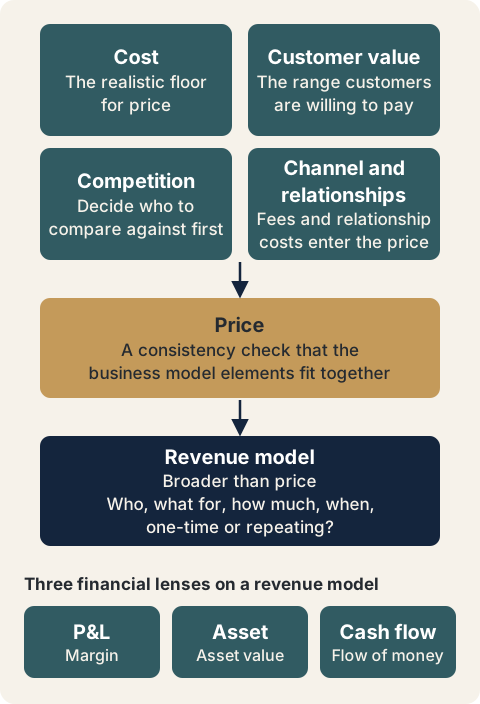
Price is not a number attached at the very end, after the product is finished. Price is closer to a result that comprehensively reflects who the customer is, what problem that customer has, what value is being delivered, how that value is delivered, and how much it costs along the way. When you view a business model as three categories — value creation, value delivery, and revenue model — price does not stay confined to revenue streams alone. You also have to look at which customer segment will pay that price, whether the value matches that price, whether the channel can sustain that price, and whether the cost of maintaining the customer relationship can be covered. In this sense, price becomes the standard of coherence that confirms whether the various elements of the business model connect to one another without contradiction.
Key resources and key activities create the cost structure; channels and customer relationships change the value customers feel and the cost of selling; and partnerships affect resource access, negotiating power, and competitive position. Choosing direct sales can reduce distribution margin, but you must handle customer acquisition and operations yourself; choosing an indirect channel increases market reach, but fees and distribution margin enter the price structure. Using partners can supplement resources you lack, but you must also examine the economic cost paid to the partner and the negotiating power involved. Without considering all of these elements together, it is difficult to set a “living price” the market will accept.
Ultimately, “what is an appropriate price?” is not a single question. Layered inside it are several questions — “who is buying?”, “why are they buying?”, “where are they buying?”, “what must we do?”, “how much does doing that cost?”, “which competitors are we being compared to?” — and price is the numerical result of provisional answers to all of these questions coming together.
2. Key Frameworks and Mental Models
Cost: the realistic floor for price
Cost is the first real-world constraint you must check to set a price, and absent a special strategic judgment, it functions as the floor that supports the price. Rather than starting from accounting line items, cost can be estimated by first listing the activities you actually need to carry out — technology development, product production, sales and distribution, personnel — and then calculating the cost required for each activity. Technology development incurs costs for research personnel, prototypes, materials, technology licensing, outsourced development, equipment, and information use; product production incurs costs for materials, production personnel, rent, outsourced processing, and transport/storage/packaging; sales and distribution incurs costs for market research, securing distribution networks, advertising, exhibitions, samples, and sales personnel. The more concrete the execution plan in the business plan, the more concrete the cost estimate becomes — a business plan is not a list of good ideas, but a process of confirming the resources needed for the execution plan and judging whether a profit remains after covering the cost of those resources and activities.
The cost derived this way can be read along several axes: fixed costs, which occur at a constant level regardless of production volume, versus variable costs, which change with production/sales volume; and direct costs, which can be traced directly to a specific product or service, versus indirect costs, which span multiple departments or products and are hard to attribute. A manufacturing company sums material costs, labor costs, and manufacturing overhead to calculate manufacturing cost; a distribution company uses purchase cost as its baseline; adding SG&A to either brings you close to total cost. Rather than applying the strict accounting distinctions between cost and expense, this chapter’s purpose is the practical perspective of grasping the “total cost of making, distributing, and selling a product” needed to examine business feasibility and price.
How you design the cost structure changes the business strategy itself. A business with high fixed costs is hard to sustain without securing a certain level of sales volume; a business with high variable costs must check whether enough profit per unit remains even as sales volume grows. A product with high manufacturing cost prompts you to consider reducing distribution stages or increasing production volume to lower unit cost. Cost analysis is not a simple accounting exercise — it is a strategic filter that makes you look again at your customers, channels, production method, and sales volume.
The three logics of pricing: cost, value, and competition
Calculating cost does not automatically determine price. Customers do not pay money to compensate the costs a company incurred internally. Customers pay because they feel the product or service solves a problem that matters to them or provides value they want. If cost creates the realistic floor for price, the range customers are willing to pay creates the other boundary of price.
Value-based pricing centers not on the cost of making the product, but on the value the customer segment assigns to it. Unlike the approach of adding a margin to cost to set a price, this approach first identifies the price range and willingness to pay that customers will accept, and then works backward to check that cost and product composition make the business viable at that price — which requires customer research and market response testing. Price connects to the positioning formed in the customer’s mind. Even products with the same functions can command different acceptable prices depending on what problem the customer perceives it as solving and what differentiated value they feel compared to substitutes. Value-added pricing — justifying a higher price by adding differentiated value rather than simply following a competitor’s price cut — is an extension of this same logic. If you want to set a higher price, you must design and prove a basis of value the customer can accept, rather than pointing to “because our cost is high.”
Competition-based pricing references competitors’ prices, but it is not simply a matter of copying the industry average. You must first decide who to compare against. Being in the same product category does not make something an actual competitor — a competitor is defined as a solution that delivers similar customer value to the same customer segment. So before comparing competitor prices, you first need to define the scope of customers, value, and substitutes. Price is also a signal that lets customers interpret the position of quality and brand. A low price can look advantageous for market entry, but once perceived as a low-price brand, moving to a premium market afterward can require significant cost and time. In particular, if a startup lacking resources and infrastructure enters low-price competition without having secured economies of scale, it may have to grow while accepting a low operating margin, increasing capital and operational risk. Conversely, a premium strategy does not work simply by raising the price. It requires the product, service, customer experience, channel, and brand together to justify a higher price. Because price is both the result of positioning and a means of reinforcing that positioning, the question should be not “how much should we charge?” but “what customer, and what value, do we want to be remembered for?” — asked together. That said, because price is a relatively easy element to change compared to product specs or distribution networks, changing it frequently can shake existing positioning and customer trust. It is more appropriate to understand pricing flexibility not as impulsive discounting, but as a strategic adjustment tool to use when other business model elements are hard to change.
Channel and customer relationship: price does not move alone
Price is not decided in isolation from channel. A specific price presumes a specific customer, presumes a channel to reach that customer, and the fees and operating costs of that channel in turn change cost and margin. Using indirect channels gives access to a wider market, but incurs distribution margin and fees. Direct channels can raise profit margin per unit, but a startup must handle acquiring customers, shipping, and service on its own. Neither side is always superior — the choice must fit the target customer, product characteristics, resources, and pace of growth, and setting a price without considering channel-specific fees can create a structure where you lose money the more you sell.
Price is a structure that must reflect not only channel but also the funds needed to maintain customer relationships. Customer relationships are more than friendly service. The activities of acquiring customers, managing the purchase experience, and driving repeat and additional purchases require personnel, systems, and promotion costs. Saying that a revenue model has been established does not mean you have set one price tag — it means you have considered, within the price structure, not just cost and margin but also the funds needed to maintain the relationship.
From price to revenue model
Setting a price does not complete the revenue model. Even at the same price, the character of the business differs depending on who pays, what they pay for, whether they pay once or repeatedly, and whether the price is fixed or changes with negotiation and market conditions. Revenue model is a broader concept than the number called price, and it must explain the structure that converts customer value into cash. You can present Osterwalder’s types of revenue streams (asset sale, usage fee, subscription fee, lending/rental/leasing, licensing, brokerage fees, advertising), but what matters in practice is not memorizing the names of the types. When examining a revenue model, it helps to compress it into a few questions: who pays, what do they pay for, how much do they pay, when does the money come in, and do they pay once or repeatedly. Once you answer these questions, the type of revenue stream sorts itself out as a result; conversely, if you start by choosing a type, you can easily lose sight of the actual customer and transaction structure.
Among these questions, whether payment repeats is one of the key criteria that distinguishes revenue models. A model where the relationship ends after a single sale and a model where continuous value proposition and relationship management after purchase generate repeat revenue have different levels of business stamina. Repeat purchase or subscription is not always the right answer, but for a business carrying fixed costs, the economics differ greatly between a structure that must secure a new customer every time and a structure where existing customers generate revenue again. When setting price, you should look not only at the initial purchase price but also at the cost required for the customer relationship and the possibility of recurring revenue.
Revenue model includes not just the amount of the price but also how that price is determined and charged. Price does not exist only as a fixed price set in advance. There is also variable price, which changes depending on the negotiating power of the parties, inventory, timing, supply and demand, and bidding conditions. Looking at B2B volume-based unit pricing or B2G procurement conditions in particular shows that the pricing mechanism itself is closely tied to the transaction relationship.
Three financial lenses
To view the revenue model more broadly, you can use three lenses drawn from the three financial statements: the margin on the income statement, the asset value on the balance sheet, and the flow of money on the cash flow statement. This distinction is not an attempt to transplant traditional accounting classifications directly into business model types — it is a practical thinking tool for looking at “where is economic value being created?” from different angles.
The P&L view is the most familiar structure: selling a product or service to generate revenue and keeping the profit that remains after costs. Here, price, sales volume, cost, SG&A, and margin are the key elements, and treating product sales margin as the entirety of the revenue model can leave you vulnerable to intensifying competition or changes in the product life cycle. The asset view looks at how the value of held assets rises through business activity. Ordinary operating profit alone may not look attractive, but when you also consider raising asset value through the business and eventually selling it, the economic meaning changes. The cash flow view asks a different question. Even when revenue is recorded, if actual cash arrives late or costs must be paid first, cash pressure can arise; conversely, in a structure where you hold the customer’s payment for a period before settling with the seller, the time and flow during which the funds stay with you becomes an important part of the business structure itself.
The three lenses do not substitute for one another. Looking at a single business simultaneously through the P&L, asset, and cash flow views reveals different economic structures within the same business. In early-stage business planning, it helps to make the revenue model more three-dimensional by asking not only “how much is the revenue?” but also “what is accumulating?” and “when does cash come in and go out?”
From Price to Revenue Model at a Glance
3. Application Process
The frameworks in this chapter can be applied in order.
- List activities and estimate cost. First write down the activities you will actually carry out — technology development, production, sales and distribution, personnel — and calculate the cost required for each.
- Organize cost structure into fixed/variable costs, direct/indirect costs, manufacturing cost, and SG&A. This confirms the realistic floor for price.
- Identify customer value and willingness to pay. Use customer research and market response testing to confirm the price range customers will accept, and work backward to check that cost and product composition make the business viable at that price.
- Define competitors and examine the positioning signal of price. First determine who offers similar value to the same customer segment, then check the conditions required by low-price and high-price strategies respectively.
- Reflect channel and customer relationship costs in the price structure. Include in the cost and margin calculation the fees and distribution margin of indirect channels, the customer acquisition and operating costs of direct channels, and the customer relationship costs of acquisition, retention, and repeat purchase.
- Design the revenue model. Organize who pays, for what, how much, when, and whether repeatedly, and decide the pricing mechanism (fixed price, negotiated price, volume price, bidding).
- Check with the three financial lenses. Confirm, from the P&L, asset, and cash flow viewpoints, what remains, what accumulates, and when money moves.
In real cases, too, this process keeps being revised depending on channel, volume, and transaction structure. In the vegan bean-to-bar chocolate case, manufacturing cost was 56% of actual sale price and SG&A was around 15%; to secure an adequate margin given this high cost structure, the company chose direct-to-consumer (D2C) online sales as its core channel, reducing distribution stages, and used part of the gap between the consumer price and the actual sale price for discounts, free gifts, and other customer relationship management. In the cosmetics container B2B case, the official supply price differed from the actual sale price based on large-volume orders. The company designed the pricing so that unit price fell while still maintaining a margin of about 25% once an order of around 200,000 units was secured, premised on economies of scale from mass production, and lowered fees by cutting intermediate distribution stages and pitching directly to cosmetics manufacturers. In the groundwater level measuring equipment B2G case, the company set a price band between the consumer price and the actual sale price to account for discounts, commissions, consignment sales fees, and the possibility of future supply-price negotiations with distribution partners arising in the public procurement process, while setting direct proposal sales to local governments as its basic channel. What the three cases have in common is that price keeps being revised by other elements of the business model. As customer, channel, production capacity, order volume, relationship cost, and partners change, the appropriate price and margin structure can change even for the same product — so it is appropriate to view price not as a fixed number but as a strategic variable to be examined as the business structure changes.
4. Common Judgment Errors
- Setting price by simply adding a margin to cost: Cost is only the floor for price; without confirming the value and willingness to pay that customers actually recognize, it is difficult to reach a price the market will accept.
- Simply copying the industry average as the competitor price: Comparing competitor prices without first defining the solutions that offer similar value to the same customer segment means comparing against the wrong benchmark.
- Not calculating the cost of a low-price strategy: This is the error of viewing a low price only as a means of market entry, without also considering the positioning cost of finding it hard to move to premium afterward and the capital/operational risk of having to grow on a low operating margin.
- Omitting channel fees and distribution margin from price design: Setting a price without considering channel-specific fees can create a structure where you lose money the more you sell.
- Leaving customer relationship cost outside the price structure: If you do not reflect the personnel, system, and promotion costs of acquisition, retention, and repeat purchase, the revenue model cannot be sustained by cost and margin alone.
- Stopping at memorizing the names of revenue stream types: If you only list names like asset sale, usage fee, or subscription, without confirming through the actual transaction structure who pays, for what, how much, when, and whether repeatedly, the revenue model stays abstract.
- Judging the business model through the P&L lens alone: Looking only at the current period’s profit, without examining the accumulation of asset value or the timing gap in cash flow, can cause you to miss a different economic structure within the same business.
- Changing price too often: Because price is a relatively easy element to change, repeatedly making impulsive discounts or adjustments can shake existing positioning and customer trust.
5. Practical Application Questions
- If we list our technology development, production, and sales/distribution activities, what cost does each incur?
- What are the fixed and variable costs, and the direct and indirect costs, of our product/service, and what is the total cost?
- What problem does the customer solve, or what value does the customer recognize, in our product? How much is their willingness to pay for that value?
- Who are the actual competitors (including substitutes) that offer similar value to the same customer segment as ours?
- What customer, and what value, do we want to be remembered for? Does our current price support that positioning?
- How do the fees and distribution margin of our chosen channel (direct/indirect) change our price and margin?
- How much does it cost to acquire, retain, and drive repeat purchase from customers, and is that reflected in the price structure?
- Who pays us, for what, how much, when, and once or repeatedly?
- Is our price a fixed price, or does it vary by negotiation, volume, or bidding? How does that method connect to the transaction relationship?
- From the three viewpoints of P&L, asset, and cash flow, what is our business creating in each?
- Based on the price, cost, margin, and revenue model organized so far, are we ready to move to the next step (business feasibility validation)?
6. Connection to the Next Chapter
This chapter’s role of designing price and revenue model ends here. You need to be able to explain what cost structure the price presumes, what value the customer recognizes, and how competition, channel, and customer relationship change that price and margin, before you can move to the next question: “how much can we actually sell at that price, and is the business sustainable?”
Three key inputs carry over to the next stage. First, the price (P) grounded in customer and value. Second, the cost and margin structure that lets the business sustain itself at that price. Third, the revenue model that explains what the customer pays for and how. If these three have not been organized, it is still too early to move on to calculating market size.
Revenue and effective market size can be explained as the product of price and Qty. To avoid confusing the Q(uality) of QCD with the Q(uantity) of sales volume, sales volume is denoted as Qty. CH07, “Validating Business Feasibility and Effective Market,” takes this P×Qty as its starting point and fully addresses Projected P&L, QCD, effective market, and market estimation by B2C, B2B, and B2G.
Key Takeaways
- Price is not a number attached last to a finished product — it is the standard of coherence that confirms whether customer, value, delivery method, and cost connect to one another in the business model without contradiction.
- Cost is estimated by listing activities (technology development, production, sales and distribution), and can be read through fixed/variable costs, direct/indirect costs, manufacturing cost, and SG&A as the realistic floor for price.
- What the customer pays for is not cost but value; value-based pricing first identifies willingness to pay and then works backward through cost and product composition.
- Competitor price should be compared not against the industry average but against solutions that offer similar value to the same customer segment, and price is also a positioning signal that shapes how quality and brand are interpreted.
- Channel fees/distribution margin and the cost of customer relationships (acquisition, retention, repeat purchase) must all be considered together within the price structure.
- Revenue model is a broader concept than the amount of the price — it includes the question of who pays, for what, how much, when, and whether repeatedly, as well as the pricing mechanism (fixed/negotiated/volume/bidding).
- Using the three financial lenses of P&L, asset value, and cash flow together reveals different economic structures within the same business.
- The three inputs of price (P), cost/margin structure, and revenue model must be organized before moving on to business feasibility validation (P×Qty, effective market estimation).
Source Map
- MN: MN06 Cost, Price, and Revenue Model
- KM: KM043–KM054 (listed by file)
- KM043-price-as-business-model-result.md — Price is a result of the business model
- KM044-activity-to-cost-estimation.md — Estimating cost from activities
- KM045-basic-cost-structure.md — Basic cost structure
- KM046-value-based-pricing.md — Value-based pricing
- KM047-competition-based-pricing-positioning.md — Competition-based pricing and positioning
- KM048-channel-pricing-economics.md — Channel and price structure
- KM049-customer-relationship-cost.md — Customer relationship cost
- KM050-revenue-streams-and-model.md — Revenue streams and revenue model
- KM051-one-time-vs-recurring-revenue.md — One-time revenue vs. recurring revenue
- KM052-pricing-mechanism.md — Pricing mechanism
- KM053-three-financial-lenses.md — The three financial lenses of a money-making structure
- KM054-price-to-feasibility.md — From price to business feasibility