CH04. Building the Value Proposition, Competitive Advantage, and Positioning
Questions This Chapter Answers
- How do you turn the problem your customer faces into a solution and an actual product or service?
- Who are our real competitors? Are competitors only companies that sell the same product?
- How do you prove the claim that our product is better with a measurable comparison?
- How does a difference from competitors become the customer’s “reason to choose us”?
- What exactly is a value proposition, and why does it change depending on the customer and the buying structure?
- What do you need to do to lodge differentiated value in the customer’s perception?
- How do you check that positioning is not out of step with Product/Price/Place/Promotion (4P)?
Learning Objectives
By the end of this chapter, you will be able to:
- Design a product configuration by organizing the customer problem through the flow “problem → attribute → solution → product/service.”
- Distinguish competing products from substitutes, and draw the boundary of competition based on the customer problem rather than the product category.
- Design comparison metrics that actually influence the customer’s purchase decision.
- Apply the check criteria that separate a mere difference from a genuine competitive advantage (importance, efficiency, superiority, visibility, preemptiveness, decisiveness, profitability).
- Tie the customer problem, solution, and reason for choice into a single line of logic and state it as a value proposition.
- Check positioning using the Business Model Story structure and judge whether positioning is consistent with the 4P.
1. Core Concepts
This chapter follows a single thread. It starts with building a product that solves the customer’s problem, moves to comparing that product against competing alternatives, and ends by lodging the advantage that emerges from that comparison in the customer’s perception.
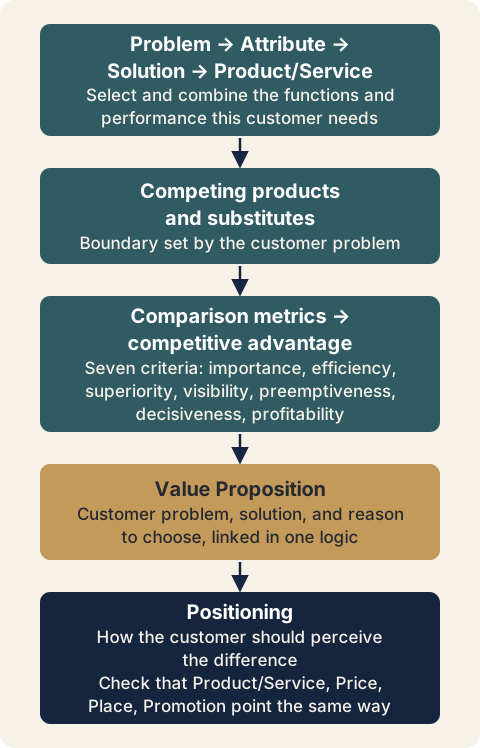
The starting point is the flow “problem → attribute → solution → product/service.” You translate the attributes of the customer problem identified in the previous stage into the language of the market, design a solution for it, and then implement that solution in a form the customer can actually purchase — the product or service. In technology startups, it is easy to mistake the underlying technology itself for the value proposition, but what the customer buys is not the name of the technology but the outcome it delivers. Likewise, product configuration is not about packing in as many features as possible; it is about selecting and combining the functions and performance a specific customer actually needs. Any spec that does not solve the customer’s core problem only adds cost.
Next, before bringing this solution to market, you need to look at what the customer is “currently” using. Competitors are not only companies that sell the same product. You must examine not just competing products within the same product category, but also substitutes that solve the same problem in a different way. If the customer problem is the same, a product or behavior that looks completely different in form can still be a competitor. The real competitor is not another company in the same industry, but any solution that delivers similar value to the same customer segment — and the scope of competition is determined by the customer problem and the value proposition, not the product category.
To actually compare the competing alternatives you have identified against your own company, you need comparison metrics. A simple declaration that “we are competitive” proves nothing. Comparison metrics itemize the value factors the customer cares about and line up your company against the competing alternatives on those items. Here, the comparison metrics must be criteria that actually influence the customer’s purchase decision — not the technical specifications the company wants to boast about. Non-technical factors such as delivery time, maintenance, ease of installation, and cost savings can matter more than technical ones.
A difference that shows up favorably in a comparison metric is not automatically a competitive advantage. A competitive advantage is not established by listing many points of difference from competitors; it is confirmed only by also asking whether that advantage is strong enough to make the customer choose you, and whether the customer would have to bear additional cost or change their behavior to adopt the new solution. In other words, a competitive advantage is “a difference that actually moves the customer’s choice and that the company can deliver repeatedly.”
The value proposition is the state in which all of this — the customer problem, the solution/product, and the reason for choosing you over the competing alternatives — is connected into a single line of logic. A value proposition is not a sentence that summarizes the product’s strengths. What it emphasizes shifts with the transaction relationship. In B2C, experiential value such as design, convenience, and brand matters alongside functional utility; in B2B, organizational outcomes for the counterpart company — cost savings, revenue growth, productivity, risk reduction — matter; in B2G, institutional fit — budget, regulation, procurement conditions — matters alongside the effect of solving the problem. A value proposition is not a fixed attribute of the product; it changes along with the customer and the buying structure.
However logically complete a value proposition is, it is useless if it does not lodge in the customer’s mind. That work is positioning. If differentiation is the work of designing “what is different,” positioning is the work of deciding “what meaning the customer will assign to that difference.” Even if you are technically superior, if the difference is not visible or does not matter in the purchase situation, you will struggle to be chosen. Positioning is not a logo or a slogan; it is the work of aligning customer choice, the problem, comparative advantage, product configuration, pricing, and channel so that they all build the same perception in the same direction.
Finally, for this positioning not to end as a mere declaration, Product/Service, Price, Place, and Promotion (4P) must all support the same direction. This stage’s role is not to expand the 4P into a detailed operating plan, but only to judge whether the chosen positioning is consistent with the direction of the product, price, channel, and communication.
2. Key Frameworks and Mental Models
Problem → attribute → solution → product/service flow. Translate the attributes of the customer problem into the language of the market, design a way to solve it, and then implement it in a form the customer can purchase — in that order. Product configuration must be “optimized to the problem and the purchase criteria.”
Distinguishing competing products and substitutes. Competing products compete within the same product category; substitutes solve the same problem in a different way. In the ocean radar case, the direct competitor is other radar systems, but if the goal is to obtain ocean current data, a buoy also becomes a substitute. In the digestive medicine case as well, the alternatives to consider include not only other digestive medicines but also the actual resolving behaviors customers choose, such as soft drinks or exercise.
Comparison metric design. Instead of a claim like “our technology is superior,” restate it as a condition and a number the customer can judge, such as “shortens the data acquisition interval from 60 minutes to 30 minutes.” Comparison metrics can include technical items such as installation space, acquisition interval, system configuration, and selling price, as well as non-technical factors such as delivery time, maintenance, and ease of installation.
Seven check criteria for competitive advantage. Check each differentiating factor from the perspective of importance, efficiency, superiority, visibility, preemptiveness, decisiveness, and profitability. Even a difference that is useful to the customer is unlikely to become a sustainable competitive advantage if it demands a cost the company cannot bear.
Value proposition emphasis by transaction relationship. The center of gravity of the value proposition shifts by relationship type: B2C (functional utility + experiential value), B2B (organizational outcomes: cost savings, revenue growth, productivity, risk reduction), and B2G (effect of solving the problem + institutional fit: budget, regulation, procurement conditions).
Business Model Story. A structure that rearranges the serious customer problem, the existing product, the competitor’s advantage, our product, and the customer value into a single story, so that “why this customer should choose us” can be explained briefly. It is used to check what meaning the value proposition should read as in the customer’s mind.
Positioning-4P alignment check. A structure in which the initial “positioning, distribution, pricing” hypothesis is reviewed against resources and cost, and the “final positioning and 4P” are then decided again. What needs to be confirmed is whether the chosen positioning is consistent with the direction of the product, price, channel, and communication.
Value Proposition and Positioning at a Glance
3. Application Process
- Reconfirm the attributes of the customer problem organized in the previous stage, and design a solution for it. Implement the solution in a product/service form the customer can actually purchase, selecting and combining only the functions and performance a specific customer needs.
- List every alternative the customer is actually using right now to solve this problem. Include both competing products within the same product category and substitutes that solve the same problem in a different way. Set the boundary based on the customer problem, not the product category.
- Decide the metrics for comparing your company against each competing alternative. Choose criteria (expressible as numbers or conditions) that actually influence the customer’s purchase decision, not the technical specifications the company wants to boast about.
- Check the differences that appear in the comparison metrics against the seven competitive-advantage criteria (importance, efficiency, superiority, visibility, preemptiveness, decisiveness, profitability). Keep only the differences that actually move the customer’s choice and that the company can deliver repeatedly.
- Tie the customer problem, the solution/product, and the reason for choice (competitive advantage) into a single line of logic and write the value proposition as a statement. Adjust the emphasis according to the transaction relationship (B2C/B2B/B2G).
- Rearrange the value proposition using the Business Model Story structure (serious customer problem - existing product - competitor’s advantage - our product - customer value), and check what meaning it will carry in the customer’s mind.
- Confirm that the chosen positioning is not inconsistent with Product/Service, Price, Place, and Promotion. Review the initial hypothesis in light of resources and cost, then finalize the direction of the positioning and the 4P. At this stage, do not build out the 4P into a detailed operating plan.
4. Common Judgment Errors
- Mistaking the technology or spec itself for the value proposition, and failing to explain the solved outcome the customer actually gets.
- Limiting “competitors” to “companies that sell the same product,” and missing substitutes that solve the same problem in a different way.
- Designing comparison metrics around the technical specifications the company wants to boast about, and failing to reflect the customer’s actual purchase-decision criteria (delivery time, maintenance, ease of installation, etc.).
- Mistaking the mere fact of being different from competitors for a competitive advantage, without checking whether that difference actually moves the customer’s choice or whether the company can deliver it repeatedly.
- Treating the value proposition as a fixed attribute of the product and reusing the same value proposition even when the customer or the buying structure (B2C/B2B/B2G) changes.
- Understanding positioning only as a communication expression like a logo or slogan, and missing that it is also the work of aligning product configuration, price, and channel in the same direction.
- At the positioning-4P alignment check stage, trying to expand the 4P to the level of a detailed operating plan and skipping the actual judgment needed — whether the directions are consistent.
5. Practical Application Questions
- What is the core customer problem our solution solves, and what change does it create for the customer as a result?
- What is the customer actually using right now to solve this problem? (Including substitutes as well as competing products)
- Are the comparison metrics we present the customer’s purchase-decision criteria, or the technical specifications we want to boast about?
- Is this difference strong enough to actually move the customer’s choice? Can we deliver this difference repeatedly?
- Is our value proposition a single connected logic of customer problem, solution, and reason for choice — or does it stop at a sentence listing strengths?
- Which of B2C/B2B/B2G does our customer fall into, and is the emphasis of the value proposition adjusted accordingly?
- When we summarize our story in one paragraph using the Business Model Story, is it clear “why this customer should choose us”?
- Does the current product configuration, price range, and channel plan point in the same direction as the chosen positioning?
6. Connection to the Next Chapter
This chapter ends by confirming that positioning is not inconsistent with the direction of Product/Service, Price, Place, and Promotion. However, it did not expand the 4P into a detailed operating plan here, nor did it address the alignment of the entire business model, including channels, customer relationships, key resources, activities, and partnerships. That is picked up in the next chapter, CH05 “Designing the Business Model.”
Key Takeaways
- What the customer buys is not the technology but the outcome it solves, and product configuration should be optimized to the problem and the purchase criteria.
- The scope of competition is set by the customer problem, not the product category, and both competing products and substitutes should be considered together.
- A claim of competitiveness must be verifiable through comparison metrics, and those metrics must be the customer’s purchase-decision criteria.
- Competitive advantage is not a mere difference; it is a difference that actually moves the customer’s choice and that the company can deliver repeatedly.
- The value proposition is a single connected logic of customer problem, solution, and reason for choice, and it changes with the customer and the buying structure.
- Positioning is the work of lodging that difference in the customer’s perception, and the product, price, channel, and communication must all point in the same direction.
- The positioning-4P alignment check goes only as far as judging whether the directions are consistent; designing the full business model is the work of the next chapter.
Source Map
- MN: MN04 Value Proposition, Competitive Advantage, and Positioning
- KM:
- KM027-problem-to-solution-product.md
- KM028-competitors-and-substitutes.md
- KM029-comparison-metrics.md
- KM030-competitive-advantage.md
- KM031-value-proposition.md
- KM032-positioning.md
- KM033-positioning-4p-alignment.md