CH02. Finding and Selecting a Business Opportunity
Questions This Chapter Answers
- Where does a business opportunity begin? Must it start from technology, or can it start from the market?
- What is the first skeleton you need to lay out before building a business plan?
- What do “Capability (T)” and “Product (P)” each mean, and why don’t they need to be fully formed from the start?
- Why is a news headline about a growing industry different from the fact that my business can actually make money?
- What should you filter out before holding onto an early item for too long?
- How should the approach that starts from what I have and the approach that starts from the market ultimately converge?
- Does T·P·M “fitting together” mean the business has been validated?
Learning Objectives
By the end of this chapter, learners will be able to:
- Explain the principle that a business opportunity is not created from a single starting point (technology, experience, market signal, etc.) but from the intersection of internal capability and external opportunity.
- State what question each of the three elements of the TPM (Technology/Capability·Product·Market) framework asks.
- Explain what T (Capability) and P (Product Hypothesis) each include, and why they should be treated as hypotheses rather than finished forms in the early stage.
- Distinguish industry from market, and explain why growth in an industry does not automatically mean growth in my market.
- State what Top-down analysis tools such as PEST, 5-Forces, the value chain, and industry maps are used “for.”
- Filter an early item using three lenses: market risk, product risk, and channel risk.
- Explain the difference between the Top-down approach and the Bottom-up approach, and explain how the two paths — T→P→M and M→P→T — converge.
- Explain that checking TPM alignment is not business validation but a procedure for confirming “readiness to move to the next step.”
1. Core Concepts
A business item does not necessarily start from only one direction. A tech founder can start from technology or research outcomes already in hand, and an existing business can find a new venture from the experience, network, and sales capability the organization already possesses. Conversely, you can first spot a growing industry or a clear demand and then work backward to define the product and technology you need. What matters is not where you started, but whether the logic connecting technology, product, and market actually holds together once you have started.
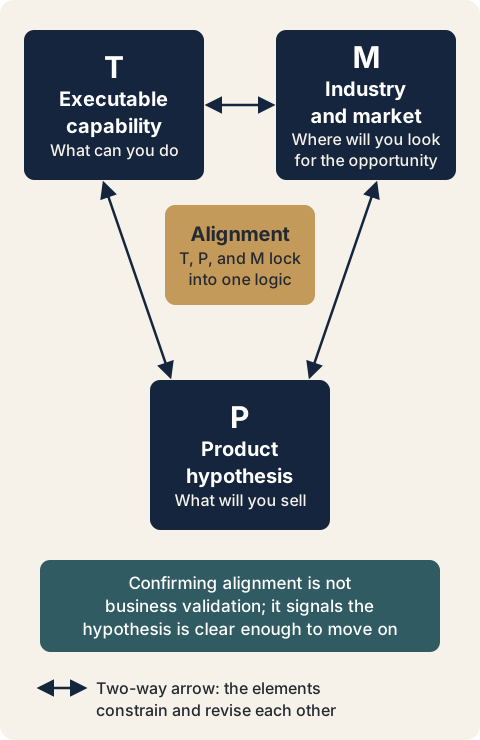
A business opportunity is not created by good external signals alone, nor by a list of internal capabilities alone. It is closer to the intersection of two conditions that can actually be connected — internal capability and external opportunity. The tool for working with this intersection is the TPM (Technology/Capability·Product·Market) framework. TPM simplifies the skeleton of a business plan into three categories: T (what can you do), P (what will you sell), and M (where will you look for the business opportunity). T needs distinctiveness, P needs value, and M needs attractiveness.
The practical benefit of TPM is that it keeps you from seeing a business item as a single product name. Looking at the product (P) alone makes it easy to get absorbed in features and specs, but looking at T alongside it forces you to ask whether that product can actually be made, and looking at M alongside it forces you to ask whether there is an opportunity in the industry and market that product would enter. TPM is not, however, a table you fill out once and finish. If T changes, the P you can build changes with it; if the regulations and competitive structure of M change, the P and T you need can shift again as well. The three elements are not an independent checklist — they are a relationship in which each constrains and revises the others.
2. Key Frameworks and Mental Models
T: Executable capability. Understanding TPM’s T only as advanced engineering technology makes it hard to apply to service businesses, content businesses, and expert-driven businesses. T extends to “capabilities I can actually execute.” Cooking skill, sales experience in a particular industry, an overseas network, or the ability to develop educational content can all serve as T if they can actually move a business forward. Still, simply possessing a capability does not by itself create business viability. When laying out T, it is more useful to ask not “what do I possess” but “what can I actually perform,” “which product can this capability be converted into,” and “will I acquire a missing capability myself or borrow it through a partner.” The value of T shows up not as a list of assets but as the point where it enables real choices in product and market.
P: Product Hypothesis. In TPM, P is not limited to a finished physical product. A concrete offer that a customer can actually choose and purchase — a service, a platform, educational content — is also included in P. What matters at this stage is not locking down every feature, but seeing which form of product a held capability can be converted into, and whether that product has a plausible connection to a market opportunity. P at this stage is still an unvalidated item hypothesis, and it is more appropriate to treat it as something to be revised later as the customer and the problem are made concrete. In other words, a business item is not the same thing as a single P. The actual business item is a provisional combination of three elements — which T will be used to build which P, and in which M the opportunity will be sought — and if any one of them changes, the meaning of the item changes as well.
M: Distinguishing industry from market. Industry is the unit for viewing the broad environment of a business — technology, companies, the value chain, the competitive structure, regulation — while market narrows that down to the customer group within the industry where a transaction can actually occur. Industry growth does not automatically mean my market grows; a business opportunity becomes concrete only once an industry-level opportunity connects to a specific buyer and a transaction. At this stage, M stays at the level of judging “in which industry and which market segment is there an opportunity,” leaving concrete customer definition and segmentation to a later stage.
Top-down analysis tools for examining this M include PEST, 5-Forces, the industry map, and the value chain. These tools are used to examine regulation, technological change, competitive intensity, the power of suppliers and buyers, and where profit flows. What matters is not completing the analysis table but using it to find risks and opportunities in the external environment and change the priority among items. Search trends, keyword data tools, and AI can also serve as supplementary means for reading market direction. These sources do not automatically hand you the correct market size — they are useful for building hypotheses about shifting interest, seasonality, keyword expansion, and new opportunity factors. Calculating the actual Effective Market size is handled later, at the feasibility review stage.
TPM Alignment at a Glance
3. Application Process
Step 1 — Set the starting point (Top-down or Bottom-up). Top-down looks at the structure of the whole industry to find risks and opportunities, while Bottom-up starts from the technology and capability I already have and works out the customer problem and product development possibilities. Using Top-down alone can find a growing industry but may leave out what I can actually do; using Bottom-up alone keeps you focused on what you do well but can trap you in an area where the market itself has little appeal.
Step 2 — Fill in T·P·M along the chosen path. T→P→M is the path of turning the capability I have into a product and finding the market that product will enter; M→P→T is the path of first discovering a market opportunity and then working backward to secure the necessary product and technology. Whichever direction you start from, T, P, and M must ultimately lock together into a single logic. This process is not one-directional — it is repeated adjustment. Just as the initial segmentation and targeting results get revised again after a review of available resources and cost, the process of external opportunity meeting internal resources has to be revisited continuously.
Step 3 — Filter the early item through three risks. Before spending a long time developing an early item, you need to quickly check the risks that could block commercialization. Review the item through three lenses: market risk (is there a sustainable, scalable industry and market), product risk (does the customer problem connect to the capability to solve it), and channel risk (even with a good product, can you reach the customer). These three risks are not a final validation model — they are an early filter for judging “is this worth investing more deeply in.” If even one of the three risks turns out to be critical, that does not mean giving up immediately. First check whether the risk can be lowered by changing the market, revising the product, or redesigning the partner or customer touchpoint.
Step 4 — Check alignment. Even if T, P, and M each look attractive on their own, it is hard to call it a good business item if they do not lock together. A distinctive capability that is never realized as a product valued in the market does not become a business; a good product cannot grow if the opportunity in the industry and market is weak. Conversely, even an attractive market cannot be executed if you cannot secure the necessary technology and capability. The core of TPM is not the individual score of each element but their alignment. Confirming alignment does not mean the business item has been validated. What is needed at this stage is whether the hypothesis has become clear enough for the next note to review. Once it is explained which capability will be used, what the product hypothesis is, and which industry and market segment to review first, you can move on to the next stage.
4. Common Judgment Errors
- Looking only at P (product) and not at T and M. Getting absorbed in the product idea (features, specs) without checking whether it can actually be built (T) or whether there is an opportunity in the industry and market it would enter (M).
- Treating T only as “a list of assets I own.” Missing that experience, network, and execution ability can be T just as much as engineering technology, or conversely, stopping at listing capabilities without asking whether they actually lead to a real product choice.
- Trying to finalize P as a finished product at the first stage. P at this stage is still a pre-validation hypothesis. Trying to lock down the severity of the customer problem, the buyer’s decision process, and the concrete solution and Value Proposition at this stage overlaps with the boundary of the next stage and leaves no room to revise the hypothesis.
- Equating industry growth with growth in my market. Judging that a business opportunity exists based only on news or statistics that an industry is growing. If you do not confirm that the industry-level opportunity connects to an actual buyer and transaction, the market may still be empty.
- Ending Top-down analysis tools as table-filling. Making PEST, 5-Forces, the value chain, and so on into a finished document as an end in itself, without connecting it to how it changes the priority among items.
- Confirming that one of the three risks is critical and either giving up immediately or, conversely, ignoring it and moving on. Risk is a filter that must be judged including the possibility of revision — it is neither a signal for instant abandonment nor something that can be ignored.
- Using only Top-down or only Bottom-up and not checking the other. Looking only at the market and missing what I can actually do, or looking only at capability and not checking market appeal.
- Mistaking confirmation of TPM alignment for “business validation complete.” Alignment means the hypothesis has become clear enough to move to the next stage — it does not mean the business has already been validated.
5. Practical Application Questions
- Am I starting from T (capability) right now, or from M (market)? Have I also checked whether this item makes sense from the opposite direction?
- If I rewrite my T not as a list of “what I possess” but as “what I can actually perform,” what is left?
- Will I acquire a missing capability myself, or will I borrow a partner’s capability?
- Is the P I am drawing right now a finished product, or is it still a hypothesis that can be revised?
- What is my basis for believing the industry I am entering is growing, and is that growth actually the same as growth in the market (customer group) I can access?
- If I run a PEST, 5-Forces, or value chain analysis, how does the result change the priority of my item?
- Among market risk, product risk, and channel risk, which is currently the weakest, and what — market, product, or channel — can I adjust to lower it?
- When I write T, P, and M as one sentence each, do the three sentences lock together, or do they each go their own way?
6. Connection to the Next Chapter
The alignment laid out in this chapter does not mean the business has been validated — it means the hypothesis has become clear enough for the next stage to review. In particular, the product risk review asked both “does the customer’s problem exist” and “can I solve that problem,” but the severity of the customer problem, the buyer’s decision process, and the concrete solution and Value Proposition were not finalized at this stage — they were left for the next stage. Likewise, in distinguishing industry from market, this chapter did not cover who the buyer is, how the user differs from the buyer, or how the boundary of the market is segmented. Chapter 3 takes up these questions left open here — the definition of the customer, the buyer, and the problem.
Key Takeaways
- A business opportunity is not created from a single starting point but from the intersection of internal capability and external opportunity.
- TPM (T·P·M) is a repeated judgment structure that simplifies the skeleton of a business plan into “what can you do, what will you sell, where will you look for the opportunity.”
- T is every executable capability, not limited to engineering technology, and P is not a finished product but an early Product Hypothesis that links T and M.
- Industry (the broad environment) and market (the actual transacting group) are different, and industry growth is not the same as growth in my market.
- Top-down tools such as PEST, 5-Forces, the value chain, and the industry map are used not to complete a table but to adjust item priority.
- Market risk, product risk, and channel risk are filters for judging whether an early item is worth investing in more deeply.
- Top-down (starting from the industry) and Bottom-up (starting from capability) are different starting points, but both paths — T→P→M and M→P→T — must ultimately lock T, P, and M together into a single logic.
- Confirming TPM alignment is not the completion of business validation — it is a signal that the hypothesis has become clear enough to move to the next stage.
Source Map
- MN: MN02 Capability·Item·Industry·Market
- KM:
- KM009-capability-opportunity-intersection.md
- KM010-tpm-framework.md
- KM011-technology-broad-capability.md
- KM012-product-hypothesis.md
- KM013-industry-vs-market.md
- KM014-external-environment-analysis.md
- KM015-market-product-channel-risk.md
- KM016-topdown-bottomup-approach.md
- KM017-tpm-alignment.md