CH04. How Channel and Customer Relationship Reshape Price Structure
Presentation key message: A sustainable price must cover not only cost and margin, but also the costs of the channel and the customer relationship.
1. Learning Objectives
By the end of this chapter, you will be able to explain how channel type (direct vs. indirect) and Customer Relationship Cost (acquisition, retention, repurchase) affect price and margin structure.
2. Core Concepts
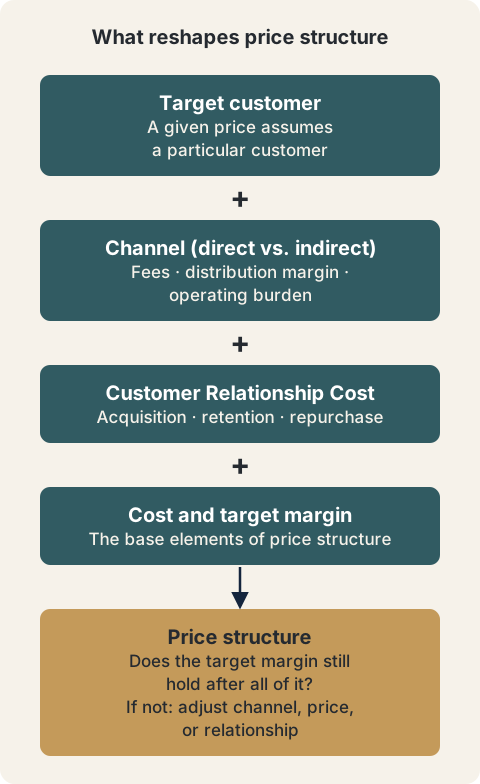
Price never moves on its own. A given price assumes a particular customer, assumes the channel used to reach that customer, and the fees and operating costs of that channel in turn reshape cost and margin. Using an indirect channel (distributors, platforms, consignment sales, etc.) gives access to a wider market, but it comes with distribution margin and fees. A direct channel (D2C, direct proposal-based sales, etc.), by contrast, can raise per-unit profitability, but it places the burden of acquiring customers and handling delivery and service on the business itself. Neither option is universally superior — the choice must be judged against the target customer, the nature of the product, available resources, and the desired pace of growth.
Price structure must account not only for channel cost but also for the resources needed to sustain the Customer Relationship. Customer relationship is not just courteous service. It is the set of activities that acquire customers, manage the purchase experience, and drive repurchase and additional purchases — and these activities require people, systems, and promotional spend. In other words, saying a revenue model is established means more than setting a single price tag: it means channel cost and Customer Relationship Cost have been considered together with cost and margin within the price structure.
3. Why It Matters
Setting a price without accounting for channel can create a structure where you lose money the more you sell. Once fees and distribution margin are subtracted, what actually remains in hand may not even cover cost. For the same reason, if Customer Relationship Cost (acquisition, retention, repurchase) is not reflected in the price structure, a price that appears to leave margin on the surface may in fact be unsustainable. Channel and customer relationship are distinct factors, but they share the same underlying principle: before asking “at what price should we sell,” both force us to ask “to whom, through what path, and through what relationship is this price being delivered.”
4. Framework / Logic
The logical structure shared by the two KMs is as follows.
- Price is not a fixed number — it is a strategic variable continuously revised by other elements of the business model (customers, channel, production capacity, order volume, relationship cost, partners).
- Channel choice (direct vs. indirect) creates a trade-off between market accessibility and per-unit profitability.
- Customer Relationship Cost (acquisition, retention, repurchase) is a cost item that exists separately from cost and margin, and must be reflected together when designing price structure.
- Even for the same product, if channel structure and Customer Relationship Cost change, the appropriate price and margin structure changes as well.
5. Application Process
- Confirm the target customer and product characteristics, and list the channels (direct/indirect) available to reach that customer.
- Check the fees, distribution margin, and operating burden for each channel.
- Identify the activities required for customer acquisition, retention, and repurchase (people, systems, promotion) and their associated costs.
- Review whether the target margin still holds once cost, channel cost, and Customer Relationship Cost are all reflected.
- If it does not hold, decide what to adjust — channel composition, price, or how the customer relationship is operated.
6. Applying This in Pricing or the Harness
In the Pricing Harness (pricing-harness-public) tool, core/schemas/client_input.schema.json defines the fields cost_item.applies_to_component and allocation_rule at the schema level, which leaves structural room for allocating cost items by channel or component in the future. However, at the present time, no function actually calculates or analyzes channel-based cost allocation. In other words, these fields exist only in the input schema for now, and there is no analytical logic that uses them to automatically derive channel-based margin or fee impact. When applying the content of this chapter in practice, cost, fees, and Customer Relationship Cost by channel must currently be organized manually or in a separate spreadsheet, and the Harness should not be expected to automate this. This is a current limitation of the tool and should be recorded separately as an area requiring future development.
7. Practical Checkpoints
- Have channel-specific fees and distribution margin been confirmed before price design?
- Does the business actually have the customer acquisition, delivery, and service capability needed to operate a direct channel?
- Has the cost of people, systems, and promotion required for customer acquisition, retention, and repurchase been reflected in the price structure?
- Is there a process to revisit price when channel structure or order volume changes?
8. Key Takeaways
Price is not determined by cost and target margin alone. Only when channel fees, distribution margin, and the cost of sustaining the customer relationship are also reflected does a truly sustainable price structure emerge. Channel and customer relationship are the two axes that show price is a strategic variable requiring continuous review.
9. Practical Questions
- Through which channel (direct/indirect) is our product/service delivered to customers, and what is that channel’s fee structure?
- How much does it actually cost to acquire customers and drive them toward repurchase, and is this reflected in the current price structure?
Source Map
- MN: MN06
- KM: KM048, KM049